How I learned that communication culture isn't about nationality—it's about organizational DNA
I used to think I understood American business culture. Direct. Explicit. Say what you mean, mean what you say. After years in tech startups and organizations across three countries, I'd become fluent in low-context communication: clear expectations, transparent feedback, and the kind of radical candor that makes things move fast.
Then I joined an American organization where everyone came from the same traditional, non-tech professional background.
And suddenly, I couldn't understand a word anyone was saying.
The Setup: A Fish Out of Water
Picture this: I'm the only non-American in the room. I'm also the only one with extensive tech and startup experience. Everyone else? Same industry, same professional pedigree, same unspoken rulebook I'd never been handed.
I thought my Mexican-German background and trilingual brain would be my superpower. Instead, it became my blind spot.
Because here's what nobody tells you about American business culture: it's not monolithic. The "direct American communication style" you read about in business books? That's startup culture, tech culture, maybe consulting culture. But many American organizations—especially those with deep institutional history and homogeneous leadership—can be as high-context as any culture on earth.
The Wake-Up Call: "That's Interesting"
My first major project. I presented a strategy I'd spent weeks developing. The response from leadership?
"That's interesting. We'll need to think about that."
In my German-Mexican brain, this meant: Great! They're intrigued. They need time to process. We're moving forward.
Three weeks later, I followed up. The project had been quietly shelved. No email. No meeting. No explanation.
"But... you said it was interesting?" I stammered.
The look I got back said everything: Oh, you sweet summer child.
Decoding the Hidden Language
Over the following months, I started keeping a translation guide. Here's what I learned:
What they said → What they meant
"That's interesting" → "No, and we're not discussing this further"
"Let's circle back on that" → "Never bringing this up again"
"I'll take that under advisement" → "Absolutely not"
"We've always done it this way" → "Stop challenging the status quo"
Silence in meetings → "We've already decided, and you weren't in that room"
"Great question" → "You're making me uncomfortable"
The kicker? When I tried to communicate the way I'd been trained—directly, explicitly, with clear action items and timelines—I was labeled as "aggressive/blunt," "not a culture fit," and "not understanding how things work here."
The Gladwell Moment: It Clicked
Then I read Malcolm Gladwell's Outliers and his analysis of the Korean Air disasters. The chapter on high-context vs. low-context communication hit me like a freight train.
Gladwell describes how Korean pilots, trained in a high-context culture where subordinates hint rather than command, couldn't override their cultural programming even when planes were crashing. The solution? Make English the cockpit language—creating psychological distance from hierarchical norms.
But here's what struck me: Gladwell assumes American = low-context.
He's wrong.
Or rather, he's only partially right. American startup culture is low-context. American tech culture is low-context. But American traditional organizational culture (think: politics)? That can be as high-context as anywhere in Asia.
The Real Divide: Not Geography, But Organizational DNA
The high-context/low-context framework isn't about nationality. It's about:
Homogeneity vs. Diversity: When everyone shares the same background, you develop shorthand. Outsiders can't crack the code.
Stability vs. Change: Long-tenured organizations develop elaborate unwritten rules. Fast-moving environments need explicit communication to survive.
Risk Tolerance: High-stakes, fast-moving environments (startups, aviation, emergency rooms, politics) require low-context clarity. Low-stakes, slow-moving environments can afford ambiguity.
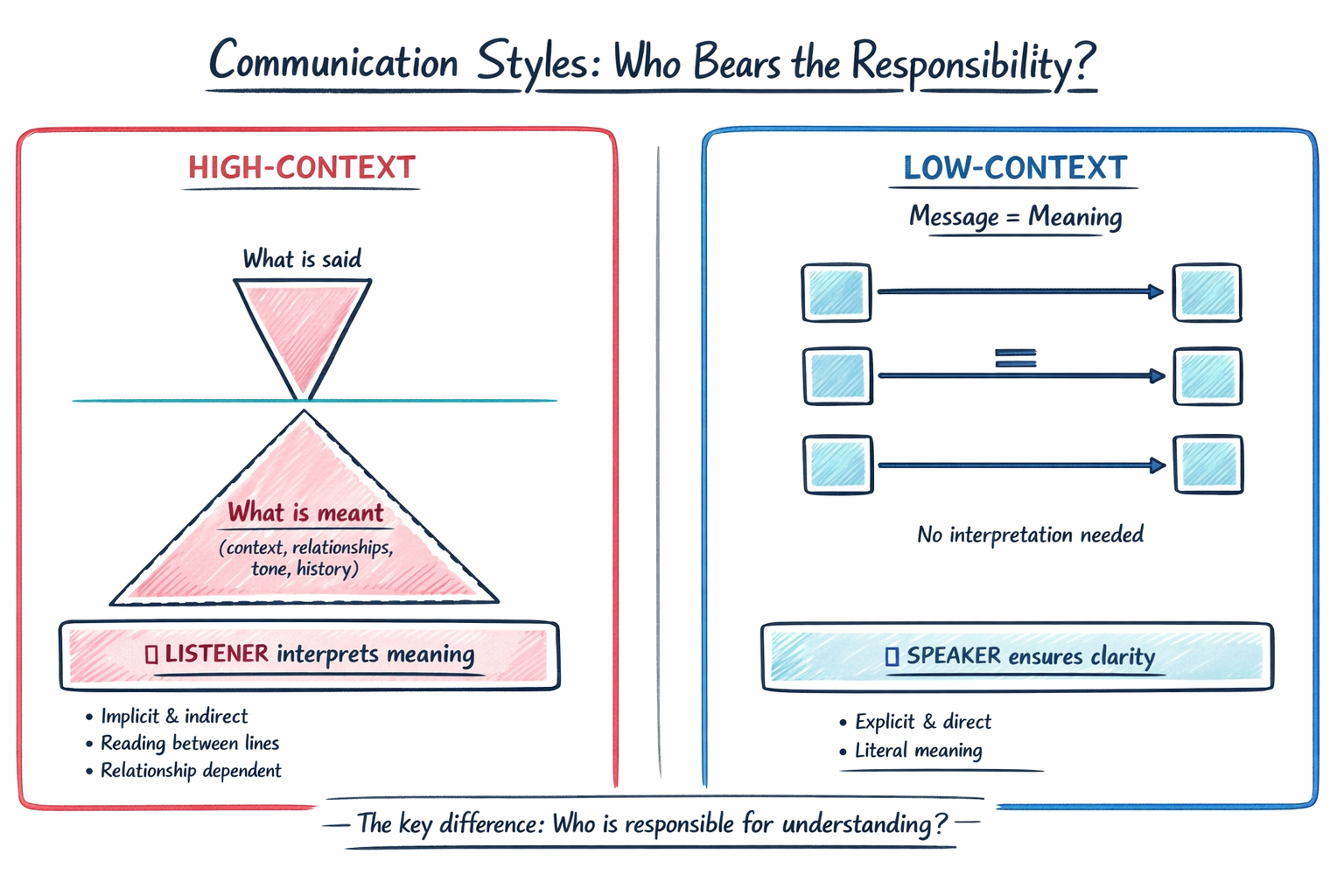
Difference between high- and low-context communication.
My American organization was:
Homogeneous (same professional background)
Stable (lots of institutional history)
Risk-averse (change was threatening)
Group Think
Of course they communicated in high-context mode. The shared context was so deep, they didn't need to be explicit—with each other. But I wasn't part of that "each other."
The Irony: I Was the "American" One
Here's the twist that still makes me laugh: As a Mexican-German with startup experience, I was communicating like the stereotypical American—direct, explicit, low-context.
And the Americans? They were communicating like the stereotypical high-context culture—indirect, relationship-dependent, reading between the lines.
The cultural assumptions were completely backwards.
Why Low-Context Leadership Is Better (Fight Me)
Now, I have opinions about this. Strong ones.
After experiencing both modes, I'm convinced that low-context communication is objectively better for leadership—especially in today's world. Here's why:
1. Safety
Remember Korean Air? People died because hints weren't heard. In any high-stakes environment—aviation, healthcare, tech infrastructure—ambiguity kills. Low-context communication saves lives or businesses.
2. Efficiency
High-context communication requires extensive shared context. Building that context takes time. In fast-moving environments, you don't have that luxury. Low-context lets you move fast with diverse teams.
3. Inclusion
High-context communication excludes outsiders by design. If you're not part of the in-group, you can't decode the messages. Low-context communication is democratic—anyone can understand, regardless of background.
4. Scalability
High-context works in small, stable, homogeneous groups. But modern organizations are global, diverse, and constantly changing. Low-context scales; high-context doesn't.
5. Accountability
When everything is implicit, nothing is accountable. "I thought you understood" becomes the excuse for every failure. Low-context creates clear expectations and clear responsibility.
The Leadership Lesson: Choose Your Context Deliberately
Here's what I learned from my experience:
High-context communication isn't a cultural inevitability—it's a choice. And often, it's a lazy choice.
It's easier to communicate in hints when everyone already agrees. It's comfortable to preserve ambiguity when you don't want conflict. It's convenient to keep outsiders confused when you want to maintain power.
But it's not better. It's just easier for the in-group.
Great leaders choose low-context communication because:
They want diverse perspectives (which requires including outsiders)
They value speed over comfort (which requires clarity)
They prioritize outcomes over politics (which requires accountability)
They build for scale (which requires explicit systems)
The Practical Shift: How to Lead Low-Context
If you're leading a team—especially a diverse, fast-moving, or high-stakes team—here's how to shift to low-context communication:
1. Make the Implicit Explicit
Don't say "That's interesting"—say "I don't think this will work because X, Y, Z."
Don't say "Let's circle back"—say "I'm declining this proposal" or "Let's schedule a follow-up for [specific date]."
Don't hint—state.
2. Create Clear Protocols
Define what "urgent" means (response time in hours, not "soon").
Establish decision-making processes (who decides what, by when).
Document expectations (don't assume people "should know").
3. Reward Directness
When someone raises a concern explicitly, thank them publicly.
When someone asks for clarity, provide it without defensiveness.
Model the behavior you want to see.
4. Build Redundancy
Multiple channels for feedback (meetings, surveys, one-on-ones).
Written confirmation of verbal decisions.
Explicit check-ins ("Do we all agree this means X?").
5. Name the Elephant
If there's tension, say it: "I sense some disagreement here. Let's surface it."
If there's confusion, acknowledge it: "I'm not sure we're aligned. Let me clarify."
If there's a problem, state it: "This isn't working. Here's what needs to change."
The Ted Lasso Test
I think about Ted Lasso a lot in my coaching work.
Ted succeeds in a foreign culture not by becoming British, but by being relentlessly clear about what he values, what he expects, and what he feels. He doesn't hint. He doesn't play games. He says "I believe in you" and means it. He says, "This isn't working," and addresses it.
That's low-context leadership. And it works across every culture.
The Bottom Line
My experience taught me something crucial: Communication culture isn't about where you're from—it's about what you choose.
American organizations can be just as high-context as any Asian company. Tech startups can be just as indirect as traditional hierarchies. The question isn't "What's your national culture?" It's "What communication culture are you building?"
And if you're building a team that needs to move fast, include diverse perspectives, and deliver in high-stakes environments?
Choose low-context. Choose clarity. Choose directness.
Your team—and your results—will thank you.
Want to talk about building a low-context leadership culture in your organization?
P.S. - That American organization? I eventually left. Not because they were bad people, but because I realized I was trying to speak English in a room full of people speaking a dialect I'd never learned. And I'd rather build teams where everyone speaks the same language—the language of clarity.
Now I help leaders make that same choice. Because in 2026, with global teams, rapid change, and high stakes, we can't afford to communicate in code anymore.
We need to say what we mean. And mean what we say.